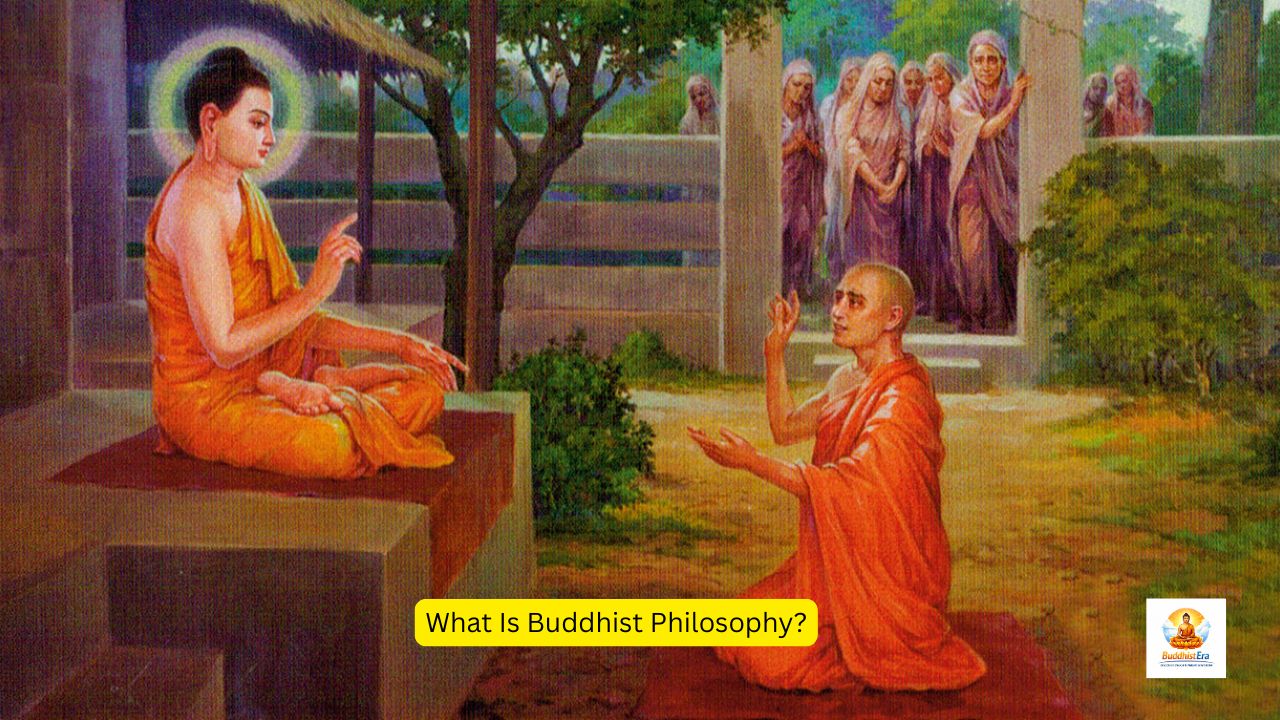
Buddhist philosophy is not just an ancient system of thought—it’s more like a practical life manual. Imagine having a toolkit that helps you deal with stress, suffering, desire, fear, and even happiness. That’s what Buddhist philosophy offers. Rooted in the teachings of Gautama Buddha, this philosophy focuses on understanding the nature of reality, the human mind, and the path to lasting peace.
Unlike many belief systems, Buddhist philosophy doesn’t ask you to blindly believe. Instead, it encourages questioning, personal experience, and mindful observation. Think of it less like a rigid rulebook and more like a compass guiding you toward clarity and balance.
Historical Background of Buddhism
Life of Gautama Buddha
Buddhist philosophy began with Siddhartha Gautama, later known as the Buddha, meaning “the Awakened One.” Born around the 5th century BCE, he lived a sheltered life as a prince. But once he encountered sickness, old age, and death, his worldview shattered.
Driven by curiosity and compassion, he renounced luxury to understand suffering. After years of meditation, he attained enlightenment under the Bodhi tree. That moment became the foundation of Buddhist philosophy.
India as the Birthplace of Buddhism
Buddhism originated in ancient India and later spread across Asia. Over time, different cultures shaped its philosophical interpretations, but the core teachings remained unchanged—understand suffering, let go of attachment, and cultivate wisdom.
Core Purpose of Buddhist Philosophy
At its heart, Buddhist philosophy seeks one thing: the end of suffering. But here’s the twist—suffering isn’t just physical pain. It includes dissatisfaction, anxiety, restlessness, and the feeling that something is always missing.
Buddhist philosophy teaches that suffering arises from craving and ignorance. By understanding how the mind works, we can break this cycle and experience inner freedom.
The Four Noble Truths
The Four Noble Truths are the backbone of Buddhist philosophy. They’re like a doctor’s diagnosis for the human condition.
The Truth of Suffering (Dukkha)
Life includes suffering. Even pleasure is temporary and often followed by dissatisfaction. This doesn’t mean life is pessimistic—it means being honest about reality.
The Cause of Suffering (Samudaya)
Suffering comes from craving—wanting things to be different than they are. Desire, attachment, and ignorance keep us trapped.
The End of Suffering (Nirodha)
Here’s the hopeful part: suffering can end. When craving fades, peace arises. This state is called Nirvana.
The Path to End Suffering (Magga)
The solution lies in the Eightfold Path, a practical guide to living wisely and compassionately.
The Eightfold Path Explained
The Eightfold Path is divided into three main areas: wisdom, ethics, and mental discipline.
Wisdom (Prajna)
Right View
Understanding reality as it is—not through assumptions, but insight.
Right Intention
Choosing thoughts of kindness, renunciation, and compassion.
Ethical Conduct (Sila)
Right Speech
Speaking truthfully and kindly. Words can heal or harm.
Right Action
Living ethically through non-violence and honesty.
Right Livelihood
Earning a living without causing harm to others.
Mental Discipline (Samadhi)
Right Effort
Cultivating positive mental states consistently.
Right Mindfulness
Being fully present—aware of thoughts, emotions, and actions.
Right Concentration
Developing deep focus through meditation.
Key Concepts in Buddhist Philosophy
Karma
Karma means action. Every thought, word, and deed shapes future experiences. It’s not fate—it’s cause and effect.
Rebirth
Buddhist philosophy teaches rebirth, not reincarnation of a soul. It’s more like a flame lighting another candle—continuity without a fixed self.
Nirvana
Nirvana is liberation from suffering and the cycle of rebirth. It’s a state of profound peace and wisdom.
Anatta (No-Self)
There is no permanent, unchanging self. What we call “I” is a collection of experiences, constantly changing.
Impermanence (Anicca)
Everything changes. Clinging to what’s temporary causes suffering.
Major Schools of Buddhist Philosophy
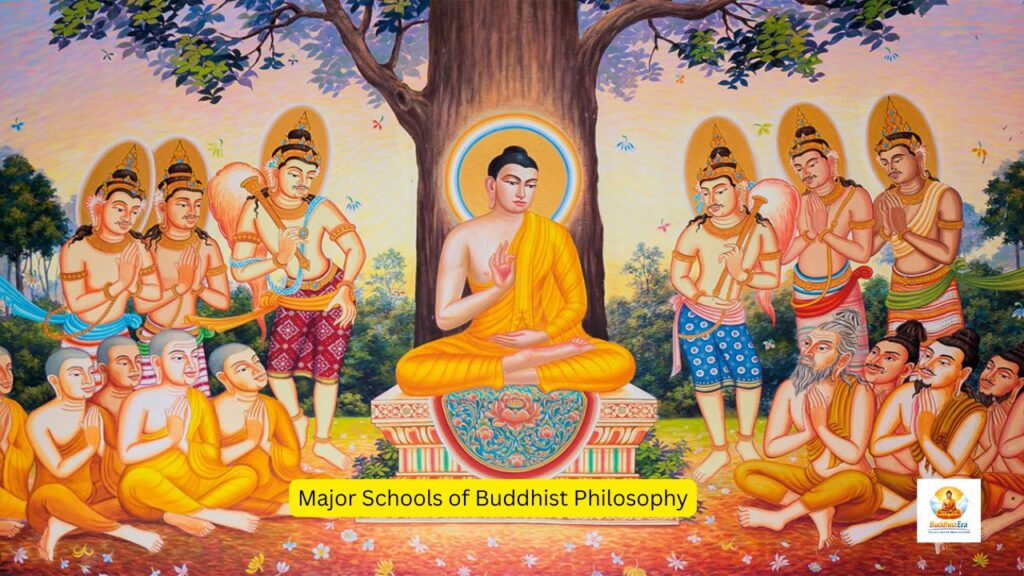
Theravāda Buddhism
Focuses on original teachings and individual enlightenment. Common in Sri Lanka and Southeast Asia.
Mahāyāna Buddhism
Emphasizes compassion and helping all beings. Popular in China, Korea, and Japan.
Vajrayāna Buddhism
Incorporates rituals and mantras. Practiced mainly in Tibet and Mongolia.
Buddhist Philosophy vs Religion
Buddhist philosophy can be practiced with or without religious rituals. It’s more about understanding the mind than worshipping a deity. Many people follow it as a philosophy of life.
Buddhist Ethics and Moral Values
Compassion, non-violence, and mindfulness are central. Ethics in Buddhism aren’t commandments—they’re guidelines for reducing harm.
Meditation in Buddhist Philosophy
Meditation is the engine of Buddhist practice. It trains the mind to be calm, clear, and compassionate. Mindfulness meditation is especially popular today.
Relevance of Buddhist Philosophy in Modern Life
In a world full of stress, Buddhist philosophy feels surprisingly modern. Mindfulness is used in therapy, workplaces, and education. The teachings help manage anxiety, anger, and burnout.
Common Misunderstandings About Buddhist Philosophy
- It’s not about escaping life
- It’s not pessimistic
- It doesn’t reject happiness
- It’s not only for monks
Read also:-
Conclusion:-
Buddhist philosophy is a timeless guide to understanding life and the mind. It doesn’t promise miracles, but it offers clarity, compassion, and inner peace. In a noisy world, it teaches us how to be still. In a chaotic mind, it shows us how to be free.
FAQs:-
1. Is Buddhist philosophy atheistic?
Yes, it does not focus on a creator god, but it’s more non-theistic than atheistic.
2. Can anyone practice Buddhist philosophy?
Absolutely. No conversion is required.
3. Is meditation necessary in Buddhism?
Yes, meditation is central to understanding the teachings deeply.
4. What is the ultimate goal of Buddhist philosophy?
The end of suffering and attainment of Nirvana.
5. Is Buddhist philosophy relevant today?
More than ever. Its teachings align well with modern mental health and well-being.