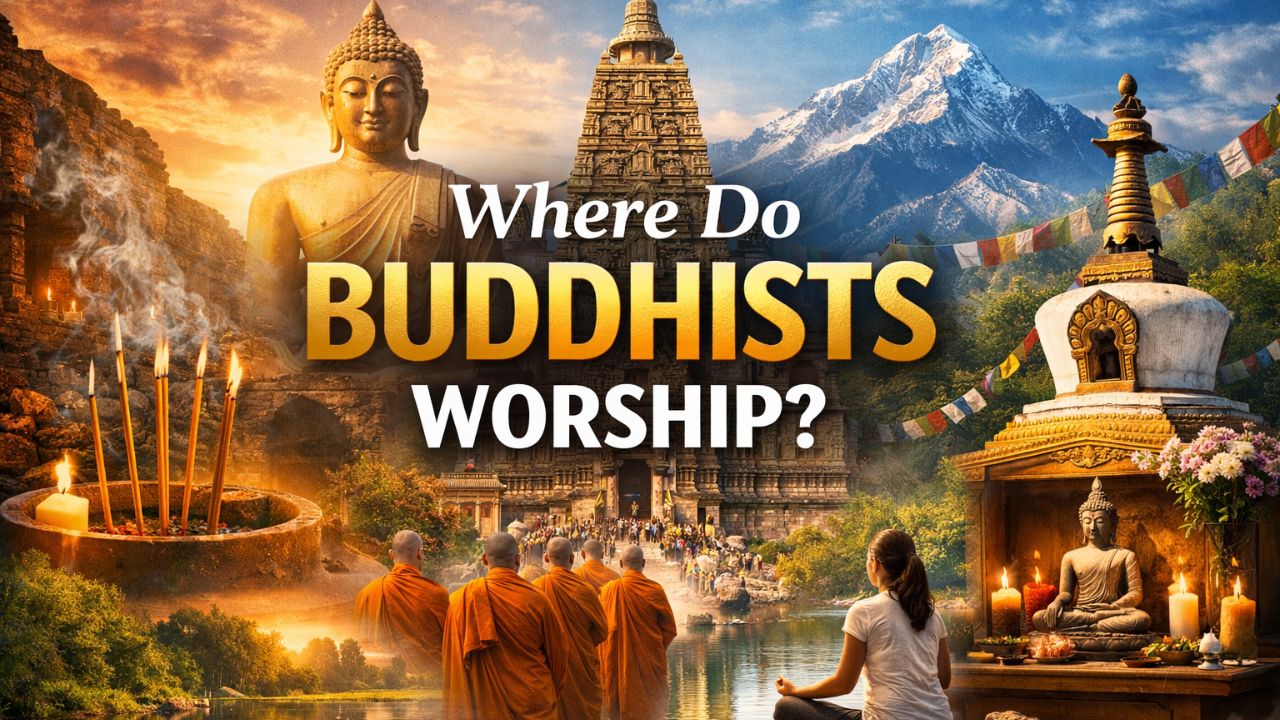
When people hear the word worship, they often imagine grand prayers, a god, or a strict ritual system. Buddhism flips that idea on its head. So, where do Buddhists worship? The simple answer is: almost anywhere. The deeper answer? That’s where things get interesting.
Buddhist worship isn’t about pleasing a god. It’s about training the mind, understanding reality, and walking the path toward enlightenment. Think of it less like asking for favors and more like polishing a mirror—slowly removing the dust so you can see clearly.
Understanding the Concept of Worship in Buddhism
In Buddhism, worship is more accurately described as practice. The focus is on mindfulness, meditation, ethical living, and wisdom. While Buddhists do gather in specific places, the true “temple” is often considered the mind itself.
Do Buddhists Worship a God?
This is one of the most common questions—and a fair one.
The Role of the Buddha
Buddhists follow the teachings of Siddhartha Gautama, known as the Buddha. He was not a god. He was a human being who attained enlightenment through deep understanding and discipline.
Respect vs Worship
Buddhists show deep respect to the Buddha, but not in the way gods are worshipped in other religions. Bowing before Buddha statues is a gesture of gratitude and humility, not a request for divine intervention. It’s like honoring a teacher who showed the way.
Main Places Where Buddhists Worship
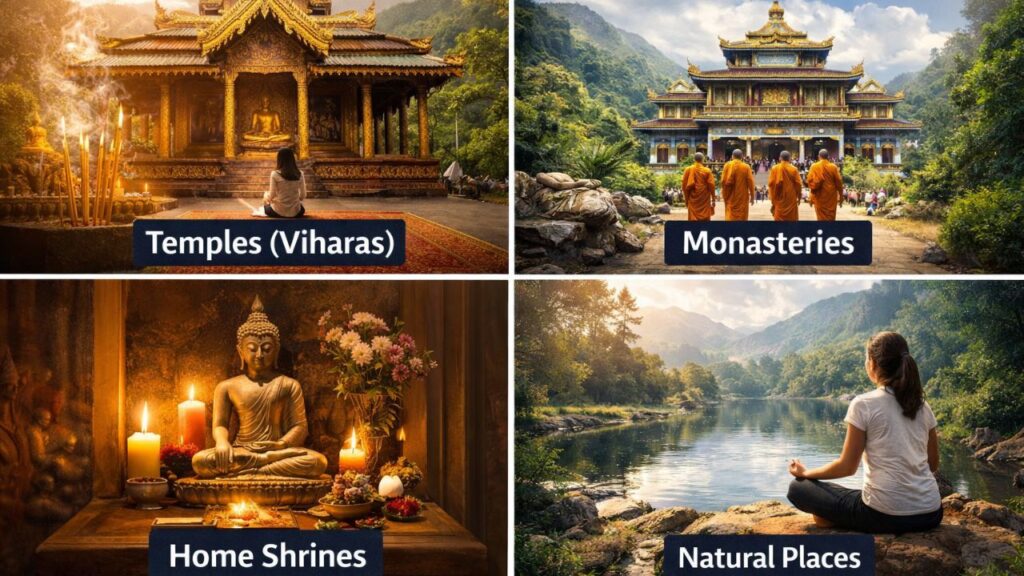
Temples (Viharas)
Buddhist temples, often called viharas, are the most recognized places of worship.
Structure and Atmosphere of a Buddhist Temple
A Buddhist temple is usually calm, quiet, and minimalistic. Inside, you’ll often find:
- A statue of the Buddha
- Incense and candles
- Prayer halls for meditation
- Monks or nuns guiding practices
The goal isn’t grandeur—it’s peace. The environment supports focus and mindfulness, like a library for the soul.
Monasteries
Monasteries are both spiritual centers and living spaces for monks and nuns.
Daily Life Inside a Monastery
Here, worship blends into daily life:
- Early morning meditation
- Chanting sessions
- Studying Buddhist texts
- Teaching lay followers
Monasteries are like spiritual universities, where learning never really stops.
Sacred Buddhist Structures
Stupas
A stupa is a dome-shaped structure that often contains relics of the Buddha or great monks. Buddhists walk around stupas in a clockwise direction as a form of meditation. Each step is intentional, each breath mindful.
Pagodas
Pagodas are multi-tiered towers commonly found in East Asia. They symbolize different stages of enlightenment and serve as landmarks of Buddhist devotion.
Home Shrines and Personal Worship
Not all worship happens in public spaces.
Setting Up a Home Shrine
Many Buddhists have a small shrine at home with:
- A Buddha image
- Candles
- Flowers
- Incense
This allows daily practice without leaving the house. It’s like having a quiet corner where the world slows down.
Natural Places of Worship
Meditation in Nature
Buddhism places huge importance on nature. Forests, mountains, rivers—these are all considered ideal places for meditation. After all, the Buddha himself attained enlightenment under a tree.
Nature doesn’t distract; it reminds.
Major Buddhist Pilgrimage Sites
Some places hold special significance for Buddhists worldwide.
Bodh Gaya
This is where the Buddha attained enlightenment. For Buddhists, visiting Bodh Gaya is like standing at the source of a river.
Sarnath
Here, the Buddha delivered his first sermon. It marks the beginning of Buddhism as a teaching tradition.
Kushinagar
This is where the Buddha passed away and entered Parinirvana. It symbolizes impermanence—one of Buddhism’s core teachings.
Lumbini
The birthplace of the Buddha. It reminds followers that even the greatest spiritual journey begins with a single birth.
Forms of Worship in Buddhism
Meditation
Meditation is the heart of Buddhist worship. It trains awareness, calms the mind, and reveals insight. No external building required—just attention.
Chanting and Mantras
Chanting helps focus the mind and cultivate compassion. The sound becomes an anchor, pulling the mind away from chaos.
Offerings
Offerings like flowers and incense symbolize impermanence. Flowers fade. Smoke disappears. Everything changes.
Differences in Worship Across Buddhist Traditions
Theravada Buddhism
Common in Sri Lanka and Southeast Asia, Theravada focuses on meditation and monastic life.
Mahayana Buddhism
Found in China, Korea, and Japan, Mahayana includes more rituals and Bodhisattva devotion.
Vajrayana Buddhism
Practiced in Tibet and Mongolia, Vajrayana uses mantras, mandalas, and complex rituals guided by a teacher.
Different paths, same destination.
Role of Community in Buddhist Worship
Community, or Sangha, plays a vital role. Practicing together strengthens discipline and motivation. It’s easier to walk the path when you’re not walking alone.
Modern Buddhist Worship Practices
Today, Buddhists also worship through:
- Online meditation sessions
- Virtual temple visits
- Mindfulness apps
The form evolves, but the essence stays the same.
Misconceptions About Buddhist Worship
Many think Buddhists “pray to statues.” In reality, statues are reminders, not idols. They point inward, not upward.
Why Place Matters Less Than Practice in Buddhism
In Buddhism, the mind is the true temple. Whether in a temple, home, forest, or busy city—practice is what counts. Enlightenment doesn’t need a postcode.
Conclusion:-
So, where do Buddhists worship? In temples, monasteries, homes, nature—and most importantly, within themselves. Buddhist worship is less about location and more about intention. It’s a journey inward, guided by awareness, compassion, and wisdom.
FAQs:-
1. Can Buddhists worship at home?
Yes, many Buddhists practice daily meditation and offerings at home.
2. Do Buddhists need temples to worship?
No. Temples help, but personal practice matters more.
3. Why do Buddhists bow to Buddha statues?
It’s a sign of respect and gratitude, not worship of a god.
4. Are monasteries open to non-Buddhists?
Many monasteries welcome visitors for learning and meditation.
5. Is meditation the main form of Buddhist worship?
Yes, meditation is central to almost all Buddhist traditions.