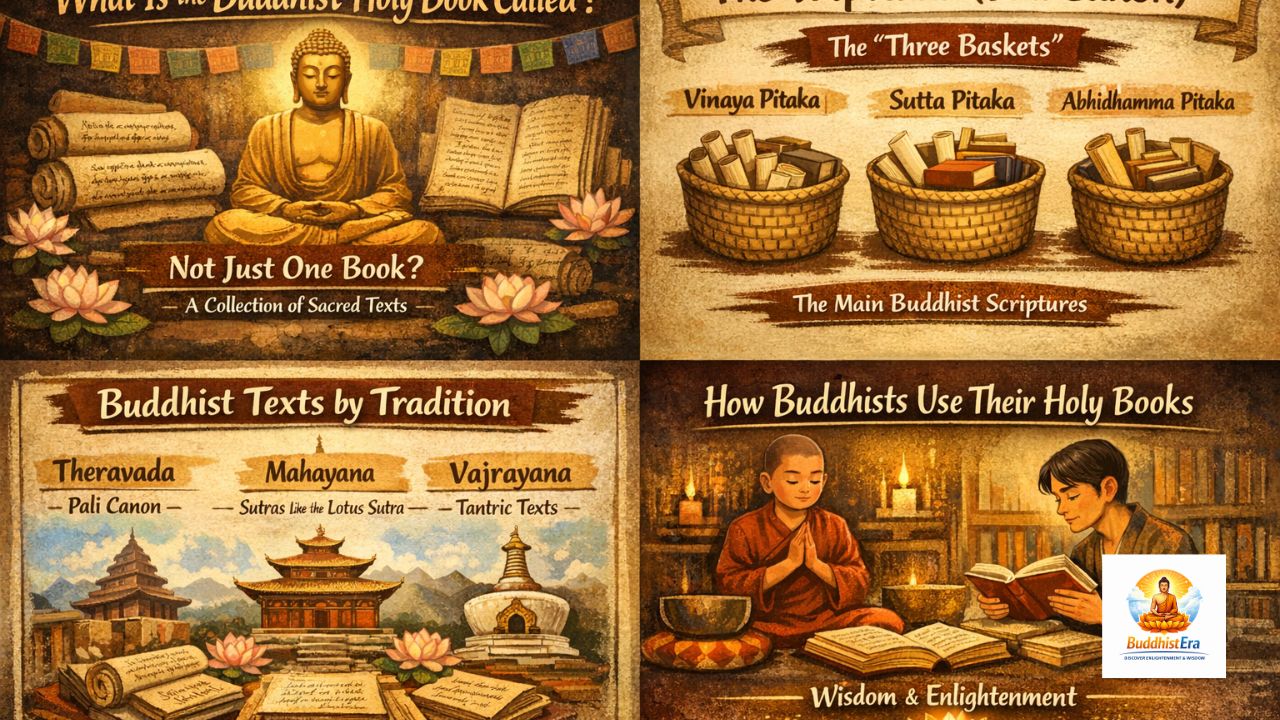
If you’ve ever wondered, “What is the Buddhist holy book called?”—you’re not alone. It’s a common question, and the answer is both simple and fascinating. Unlike many religions that revolve around a single sacred book, Buddhism follows a slightly different path. Think of it less like one thick novel and more like an entire library filled with wisdom.
Buddhism is deeply rooted in teachings, practices, and lived experience rather than blind belief. And that philosophy reflects clearly in its sacred texts.
Why Buddhism Doesn’t Have One Single Holy Book
Here’s the key thing: Buddhism does not have just one holy book like the Bible in Christianity or the Quran in Islam. Instead, it has a collection of scriptures that record the teachings of Gautama Buddha and his disciples over centuries.
Why so many texts? Because Buddha encouraged inquiry, understanding, and personal experience rather than rigid doctrine. His teachings were passed down orally for hundreds of years before being written.
Understanding the Concept of “Dharma”
In Buddhism, the heart of all teachings is the Dharma—the universal truth and the Buddha’s teachings on how to overcome suffering. The holy books are simply vessels that carry this Dharma forward.
The Main Buddhist Holy Book – Tripitaka
Meaning of the Word Tripitaka
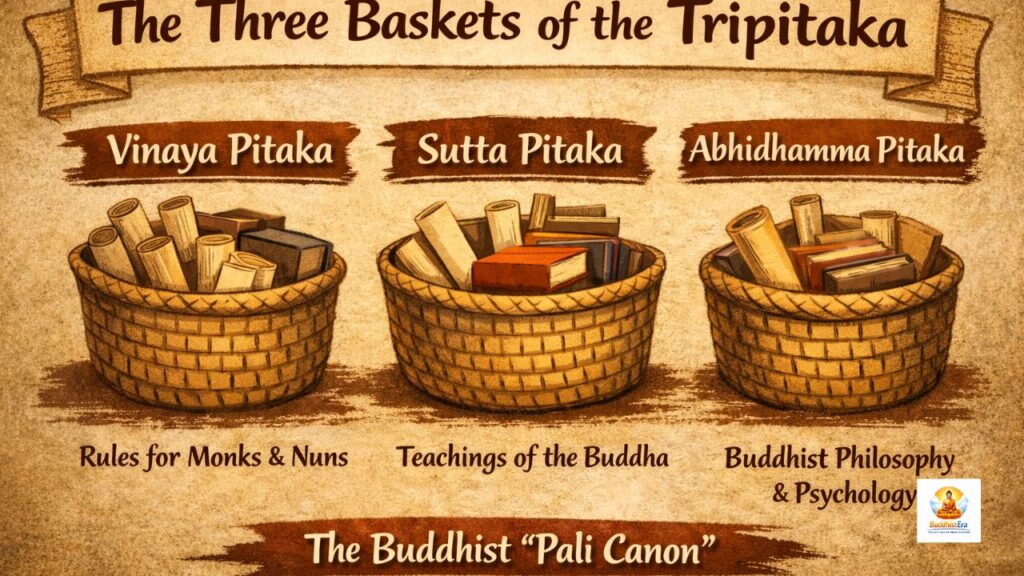
The most important and widely recognized Buddhist holy scripture is called the Tripitaka, which literally means “Three Baskets.”
Why baskets? Imagine ancient monks carefully collecting and sorting teachings into three baskets—each with a specific purpose.
Why It Is Also Called the Pali Canon
The Tripitaka is also known as the Pali Canon because it was written in the Pali language, an ancient language closely related to what Buddha spoke.
For Theravada Buddhism, this is the most authoritative and complete collection of Buddhist teachings.
The Three Baskets of the Tripitaka
Vinaya Pitaka
Rules for Monks and Nuns
The Vinaya Pitaka focuses on discipline. It lays down the rules and ethical guidelines for monks and nuns—how they should live, behave, dress, and interact with society.
Think of it as the backbone of monastic life. Without discipline, spiritual practice can lose its direction.
Sutta Pitaka
Teachings and Discourses of Buddha
This is the heart of Buddhism for many followers. The Sutta Pitaka contains sermons, dialogues, and teachings given directly by Buddha.
Here you’ll find:
- The Four Noble Truths
- The Eightfold Path
- Stories, parables, and practical advice for daily life
If Buddhism were a conversation, the Sutta Pitaka would be Buddha speaking directly to you.
Abhidhamma Pitaka
Buddhist Philosophy and Psychology
This basket dives deep—very deep. The Abhidhamma Pitaka analyzes reality, mind, and mental processes in a highly detailed and systematic way.
It’s more philosophical and psychological, often studied by advanced practitioners. Think of it as the science behind meditation and awareness.
Different Buddhist Traditions and Their Texts
Theravada Buddhism Scriptures
Theravada Buddhism, practiced mainly in Sri Lanka, Thailand, Myanmar, and Cambodia, relies heavily on the Tripitaka (Pali Canon) as its core scripture.
Mahayana Buddhism Scriptures
Mahayana Buddhism expanded the textual tradition. Along with the Tripitaka, it includes additional Mahayana Sutras, such as:
- Lotus Sutra
- Heart Sutra
- Diamond Sutra
These texts emphasize compassion, wisdom, and the Bodhisattva path.
Vajrayana Buddhism Scriptures
Vajrayana Buddhism, common in Tibet and Mongolia, includes tantric texts, mantras, and rituals. It blends Mahayana philosophy with esoteric practices.
Other Important Buddhist Texts
Mahayana Sutras
These sutras focus on universal compassion and enlightenment for all beings. They are poetic, symbolic, and deeply philosophical.
Tibetan Book of the Dead
Known as Bardo Thodol, this text guides consciousness through death and rebirth. It’s read during funerals and meditation on impermanence.
Lotus Sutra and Heart Sutra
- The Lotus Sutra teaches that everyone has the potential to become enlightened.
- The Heart Sutra famously declares: “Form is emptiness, emptiness is form.”
Short, powerful, and profound.
Languages of Buddhist Holy Books
Pali Language
The earliest and most authentic Buddhist texts were preserved in Pali, especially for Theravada traditions.
Sanskrit and Tibetan
Many Mahayana and Vajrayana texts were written or translated into Sanskrit and Tibetan, adding depth and regional interpretation.
Chinese Translations
As Buddhism spread to China, Korea, and Japan, scriptures were translated into Chinese, shaping East Asian Buddhism.
How Buddhists Use These Holy Books
Chanting and Meditation
Texts are chanted daily in monasteries and homes. Chanting isn’t about memorization—it’s about mindfulness and vibration of meaning.
Study and Daily Practice
Buddhists study scriptures as guides, not commandments. The goal is practice, experience, and transformation.
Is the Tripitaka Still Relevant Today?
Modern Interpretations
Absolutely. Modern teachers interpret ancient teachings for stress, anxiety, mindfulness, and personal growth.
Digital Buddhist Scriptures
Today, the Tripitaka and other sutras are available online, in apps, and in translations—making ancient wisdom accessible to everyone.
Common Misconceptions About Buddhist Holy Books
- Buddhism is not book-centered, but practice-centered
- Texts are guides, not divine orders
- No single book defines all Buddhists
Conclusion:-
So, what is the Buddhist holy book called? The most accurate answer is the Tripitaka, also known as the Pali Canon. But Buddhism doesn’t stop there. Its wisdom flows through many texts, languages, and traditions.
Rather than clinging to one book, Buddhism invites you to read, reflect, practice, and experience. The real “holy book” is ultimately your own awareness.
FAQs:-
1. What is the main holy book of Buddhism?
The main holy book is the Tripitaka (Pali Canon).
2. Is the Tripitaka written by Buddha himself?
No, it was compiled by Buddha’s disciples after his death.
3. Do all Buddhists follow the same book?
No, different traditions follow different collections of texts.
4. What language are Buddhist scriptures written in?
Mainly Pali, Sanskrit, Tibetan, and Chinese.
5. Can non-Buddhists read Buddhist holy books?
Yes, anyone can read and learn from them—Buddhism is open to all.