Have you ever wondered, “What language do Buddhists actually speak?” Is it Sanskrit? Pali? Tibetan? Or something else entirely?
The short answer is: Buddhists speak many languages. There is no single “Buddhist language.” Instead, Buddhism flows like water—it adapts to the land, culture, and people it touches.
Let’s dive in and explore this fascinating topic together.
Why Language Matters in Religion
Language is more than just words. It carries emotions, beliefs, and traditions. In religion, language becomes a bridge between humans and spiritual ideas.
Think of language like a vehicle. The destination is enlightenment. The vehicle may change, but the destination stays the same.
Diversity in Buddhist Communities
Buddhism exists in more than 150 countries. From Japan to Sri Lanka, from Nepal to New York, Buddhists come from every background imaginable. Naturally, their languages are just as diverse.
Is There One Official Buddhist Language?
Understanding Religious vs Cultural Language
Some religions rely heavily on one sacred language. Buddhism is different.
Buddha taught in the language of ordinary people, not in elite or royal languages. His goal was simple: make wisdom accessible.
Why Buddhism Has No Single Language
Buddhism spread peacefully through trade, travel, and teaching. Wherever it went, it adopted local languages. This flexibility helped it survive and thrive for over 2,500 years.
So no—there is no “official” Buddhist language.
Ancient Languages of Buddhism
While Buddhists speak many modern languages, some ancient languages hold special importance.
Pali – The Language of Theravāda Buddhism
Pali is one of the oldest Buddhist languages. It is mainly used in Theravāda traditions found in Sri Lanka, Thailand, Myanmar, and Cambodia.
Pali Canon and Scriptures
The Tipitaka (Pali Canon) is written in Pali. It contains teachings, rules, and philosophy of early Buddhism.
Many monks still study Pali today, much like scholars study Latin.
Sanskrit – The Classical Buddhist Language
Sanskrit became important in Mahayana Buddhism, especially in India and Central Asia.
Mahayana Texts in Sanskrit
Famous texts like the Lotus Sutra were originally written in Sanskrit. Over time, they were translated into many languages.
Regional Languages Used by Buddhists
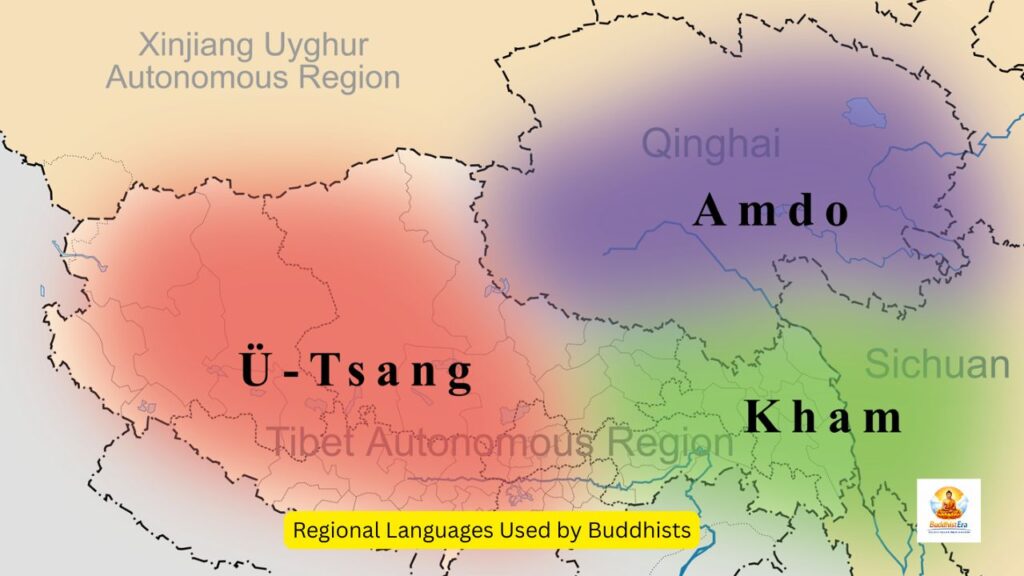
Let’s look at how Buddhism sounds in different parts of the world.
Chinese in East Asian Buddhism
In China, Taiwan, and parts of Korea, Buddhist scriptures are mostly in Classical Chinese.
Many chants and ceremonies still use this ancient form.
Tibetan in Himalayan Buddhism
In Tibet, Nepal, and Bhutan, Tibetan is central to Buddhist practice.
Thousands of Sanskrit texts were translated into Tibetan, creating one of the largest Buddhist libraries in history.
Japanese in Zen and Pure Land Traditions
Japanese Buddhism uses Japanese in daily practice, with some Chinese-based chants.
Zen temples often mix Japanese and classical phrases.
Thai, Burmese, and Khmer in Southeast Asia
In Southeast Asia, monks teach in local languages like Thai, Burmese, and Khmer, while chanting in Pali.
It’s like speaking English at home but singing in Latin at church.
Modern Languages in Contemporary Buddhism
English and Global Buddhism
Today, English plays a huge role in spreading Buddhism worldwide.
Books, podcasts, YouTube channels, and retreats often use English to reach global audiences.
Buddhism in Western Countries
In the USA, UK, Australia, and Europe, most Buddhist centers teach in local languages—English, French, German, Spanish, and more.
This makes Buddhism accessible to everyone.
Language in Buddhist Rituals and Chanting
Why Ancient Languages Are Still Used
You might hear monks chanting in Pali, Sanskrit, or Tibetan. Why not modern languages?
Because these ancient words carry tradition, rhythm, and spiritual depth. They connect today’s practitioners to centuries of wisdom.
Meaning of Mantras and Chants
Mantras are not just words. They are sound vibrations meant to calm the mind and awaken awareness.
Even if you don’t understand every word, the sound itself has power.
How Monks and Nuns Learn Languages
Traditional Monastic Education
In monasteries, students learn sacred languages alongside meditation and philosophy.
They memorize texts, study grammar, and practice recitation.
Modern Language Training
Today, many monks also learn English, Mandarin, or Hindi to teach internationally.
Spiritual teachers now travel like global ambassadors.
Role of Translation in Buddhism
Translating Sacred Texts
Translation has always been central to Buddhism. Without it, teachings would stay locked in one culture.
Thousands of scholars spent their lives translating texts.
Challenges in Translation
Some Buddhist ideas don’t translate easily. Words like “Dharma” or “Nirvana” carry deep meanings.
It’s like trying to pour the ocean into a cup—something is always lost.
Digital Age and Buddhist Languages
Online Teachings and Apps
Apps, websites, and online retreats now offer teachings in dozens of languages.
You can meditate with a teacher from another continent in real time.
Social Media and Dharma Sharing
Instagram, YouTube, and podcasts spread Buddhist wisdom in simple, modern language.
Dharma now fits in your pocket.
Common Misconceptions About Buddhist Language
Myth vs Reality
Myth: All Buddhists speak Sanskrit.
Reality: Most never do.
Myth: You must know Pali to practice.
Reality: Understanding matters more than language.
How Language Shapes Buddhist Practice
Understanding Teachings Through Language
When teachings are in your mother tongue, they hit deeper. You don’t just hear them—you feel them.
Personal Connection to Dharma
Language creates intimacy. It turns philosophy into personal guidance.
Learning Buddhist Languages as a Student
Should You Learn Pali or Sanskrit?
If you love deep study, learning Pali or Sanskrit can be rewarding.
But it’s not required for spiritual growth.
Beginner-Friendly Options
Start with translations. Learn basic chants. Focus on practice first.
Wisdom comes from experience, not vocabulary.
Future of Language in Buddhism
Globalization and Change
As the world connects, English and Mandarin may dominate Buddhist education.
But local languages will always matter.
Preservation of Ancient Texts
Digital archives now protect ancient manuscripts for future generations.
Technology is becoming Buddhism’s new library.
Cultural Identity and Language in Buddhism
Language as Cultural Heritage
Language keeps traditions alive. It preserves rituals, songs, and stories.
Community and Communication
Shared language builds strong spiritual communities.
It turns strangers into sangha (spiritual family).
Comparing Buddhism with Other Religions
Language Differences Across Religions
Some religions emphasize one sacred language. Buddhism emphasizes understanding.
It cares more about meaning than pronunciation.
Practical Examples of Buddhist Languages Today
Temples Around the World
- Thailand: Thai + Pali
- Japan: Japanese + Classical Chinese
- USA: English
- Tibet: Tibetan
Real-Life Experiences
A monk in India may teach in Hindi, chant in Pali, and write in English—all in one day.
That’s modern Buddhism.
Read also:-
Conclusion:-
So, what language do Buddhists speak?
They speak the language of their people.
From Pali to English, from Tibetan to Spanish, Buddhism adapts like a river flowing through different lands. Its true language is not found in dictionaries—it lives in compassion, mindfulness, and wisdom.
If you understand the message, you already speak “Buddhist.”
Frequently Asked Questions (FAQs)
1. Do all Buddhists learn Pali or Sanskrit?
No. Most Buddhists never study these languages. Translations are enough for practice.
2. What is the most common Buddhist language today?
English is becoming the most widely used global language for Buddhist teachings.
3. Can I practice Buddhism in my own language?
Yes, absolutely. Buddhism encourages learning in your native language.
4. Are mantras effective if I don’t understand them?
Yes. Their sound and intention matter as much as their meaning.
5. Should beginners study ancient Buddhist languages?
Not necessary. Focus on meditation and understanding first.